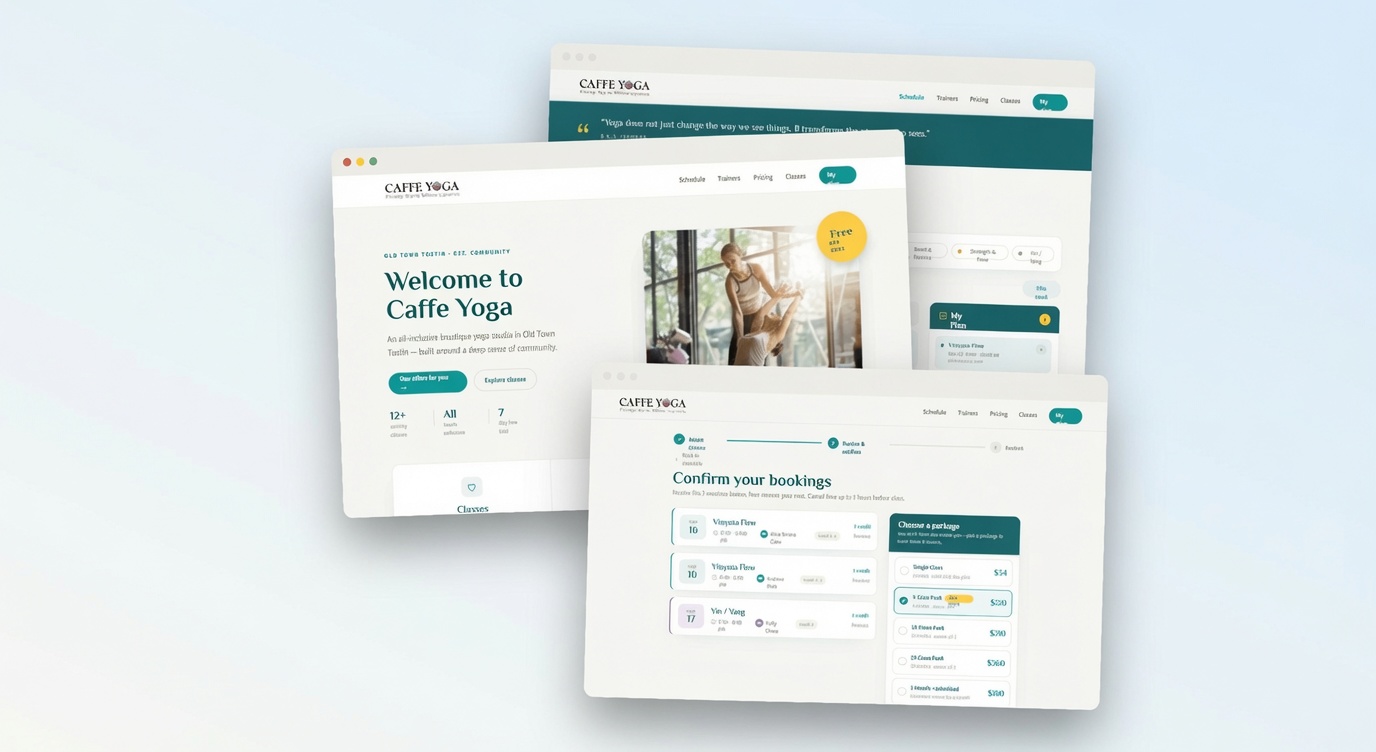
UX ResearchRe-designWebsite
Caffe Yoga
A self-initiated redesign helping visitors explore classes, instructors, memberships and events.
View caseTaskora Booking Assistant
A full scope from problem to booking chat bot: diagnose → match trade → book slot.
A conversational booking assistant that lets someone describe a household problem in plain language and reach a confirmed appointment, without knowing which trade they need or reading a service list.
The assistant asks a short diagnostic sequence, maps the answers to the right professional, then hands over an upfront price and the next available slots.
People know what is broken, not who fixes it.
Real requests were collected and grouped into the intents the assistant has to recognise.
A happy path plus repair paths were drawn, so the bot can recover from vague or partial answers.
A calm, practical voice was defined with sample turns for confirmation, error and hand-off.
The script was prototyped and tested in wizard-of-oz sessions to catch dead ends.
Collected requests were grouped into four intents the assistant has to recognise from the very first message.
“Water is dripping under my kitchen sink.” The most common entry point, and never a trade name.
“I need an electrician.” Already diagnosed, so the assistant skips straight to scoping the job.
“How much does a boiler service cost?” Answered with a range before any booking pressure.
“Can I move Thursday to the weekend?” Reschedule and cancel handled in the same thread.
The happy path runs down the middle, with a written repair path for every way the conversation can slip: a vague answer, a wrong diagnosis, a request outside scope, no availability, or silence.
The happy path written out, from an undiagnosed symptom to a confirmed booking.
Hi, I'm the Taskora assistant. What's going on at home?
There's water under my kitchen sink.
Got it. Is the water dripping slowly, or is it running while you use the tap?
Only when I use the tap.
That sounds like a leaking waste pipe, so a plumber is the right fit. Shall I look for one near you?
Yes please.
Plumbers near you start at €65 for a call-out. Earliest slots are today 16:00 or tomorrow 09:00.
Tomorrow morning.
Booking a plumber for tomorrow at 09:00, leaking waste pipe under the kitchen sink. Confirm?
Each turn asks for a single piece of information, so nothing has to be re-read or re-typed.
The trade, the job and the slot are each read back in plain words before anything is booked.
Vague answers, wrong guesses, no availability and silence all have a written recovery path.
Asking for a person is treated as a valid intent at any point, not as a failure state.
A written conversation that carries someone from a described symptom to a confirmed appointment in nine turns, with a repair path for every point where the conversation can break.
People describe symptoms, not trades, so diagnosis has to come before matching.
Every question the bot asks must earn its place, each one is a chance to drop out.
A clear hand-off to a human is a feature, not an admission of failure.
A self-initiated redesign helping visitors explore classes, instructors, memberships and events.
View caseWhether you're building a product, improving an existing experience, or looking for thoughtful UX feedback, I'd love to collaborate.